
Fifty Years of Jenggala
There is a distinct weight to a well-made ceramic plate. It sits comfortably in the hand, holding the temperature of the food it carries and bearing the faint, honest marks of the human hands that shaped it. To understand Jenggala, which celebrates its fiftieth anniversary this year, one must understand this appreciation for the functional objects of daily life.
What began in 1976 as a small, practical experiment in Sanur has grown into a quiet cornerstone of international design. As the pioneering ceramic studio and producer in Bali and across Indonesia, Jenggala established a completely new template for regional craftsmanship. It is a story rooted in family, friendship, and the unpredictable nature of working with fire and earth.
The Genesis of an Honest Need
The story begins a little before 1976 at Tandjung Sari, a gentle beachside hotel run by the Waworuntu family. In those early days, the hotel dining room served its guests on beautiful, antique chinaware. These pieces were gathered over time from various individuals, small antique shops, and family collections across the region. They gave the dining tables a singular, lived-in charm, but they also presented a persistent practical challenge.
As the years went by, daily use took its toll. Plates were chipped, teacups were broken, and occasional pieces quietly disappeared. Finding exact replacements for mismatched antiques was nearly impossible, and the table service began to lose its cohesion.
Wija Waworuntu, the observant owner of Tandjung Sari, realised the hotel needed a reliable supply of durable tableware that matched the relaxed, thoughtful atmosphere of the property. Rather than importing standard factory-made dishes from Europe or Japan, he decided to look closer to home.
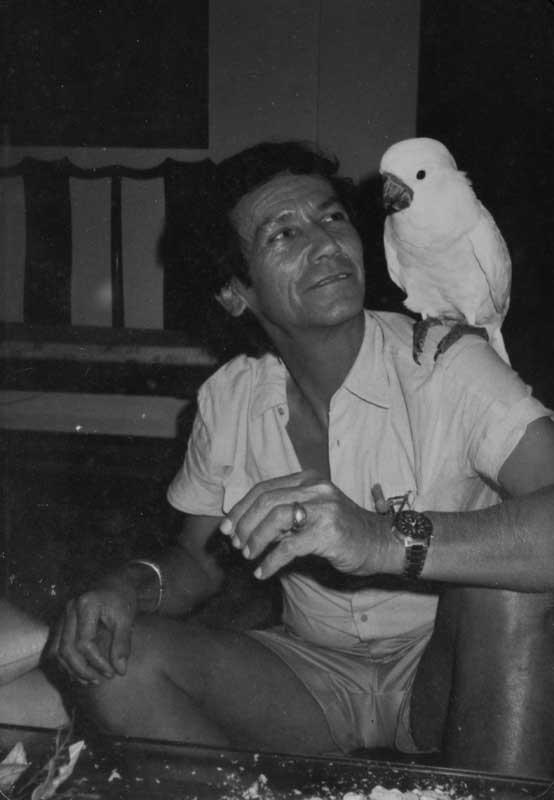
Wija turned to his friend, Brent Hesselyn, a talented pottery maker born in New Zealand who was spending time on the island. Wija asked Brent if he could create custom ceramics to replace the vanishing chinaware. Brent agreed, and Wija’s daughter, Ade Waworuntu, joined the effort. Together, they formed a trio anchored by different skills: Wija provided the hospitality vision, Brent brought the essential technical pottery expertise, and Ade offered the vital coordination to bring the project to life.
A Master of the Craft
To appreciate the foundation of Jenggala, one must understand the immense contribution of Brent Hesselyn. Brent was not merely a technician operating a wheel; he was a true artist with a profound respect for the raw potential of clay. He brought a refined, clean design sensibility from New Zealand’s rich pottery tradition and adapted it beautifully to the Indonesian archipelago.
When he first came to Indonesia in the early 1970s, his expertise found its regional application on the neighbouring island of Lombok, where he was deeply involved in developing the traditional terracotta ceramic industry. This formative time working with the foundational earthenware of Lombok gave him a nuanced, hands-on understanding of regional raw materials and traditional hand-building techniques well before establishing his roots in Bali.
In the mid-1970s, studio pottery was virtually non-existent in Bali, meaning Brent had to build an entire craft ecosystem from scratch once the Bali workshop began. He spent countless hours researching regional clay compositions, experimenting with raw minerals to develop unique glazes, and designing the initial shapes that would define the company’s identity for decades.
More importantly, Brent was a patient and dedicated educator. He trained the first generation of Indonesian ceramic makers at the studio, passing down precise techniques of throwing, turning, and glazing. His artistic DNA, which balanced functional utility with clean, organic lines, remains the guiding philosophy of the studio today. His quiet dedication turned a simple workshop into a legitimate centre for ceramic excellence.
The Kitchen Oven Experiment and Early Hurdles
The group took over a small plot of land near the Batujimbar Estate in Sanur to set up a makeshift workshop. They gathered regional clay, set up simple worktables, and Brent began throwing initial prototypes. However, the fledgling workshop faced immediate, fundamental obstacles.
In the 1970s, basic infrastructure in Bali was incredibly limited. Landline telephones were a rare luxury, restricted to a few essential points, which made communication and logistics exceptionally difficult for a new ceramic studio. Sourcing raw materials, coordinating deliveries, and finding specialised equipment required physical journeys and reliance on word of mouth.
Furthermore, they did not possess a proper ceramic kiln capable of high-temperature firing. Unwilling to let the lack of equipment halt their progress, they decided to improvise, carefully packing the raw clay prototypes into the large baking oven inside the main commercial kitchen of the Tandjung Sari hotel.
The experiment was far from an immediate success. A standard kitchen baking oven can only reach a fraction of the intense heat required to vitrify clay and mature ceramic glazes. When the oven doors opened, the results were fragile, under-fired, and largely unusable for a busy restaurant service. “Although the initial results were not ideal, they learned a lot from the whole process,” reflects Aviadi Purnomo, the current General Manager of Tandjung Sari and son-in-law of Wija Waworuntu, in a firsthand account documented for the hospitality study Paras. He notes that the workshop grew directly from necessity: “Jenggala was created to fulfil our need for chinaware in Tandjung Sari.”
The Lineage of a Name and the Sanur Dynamic
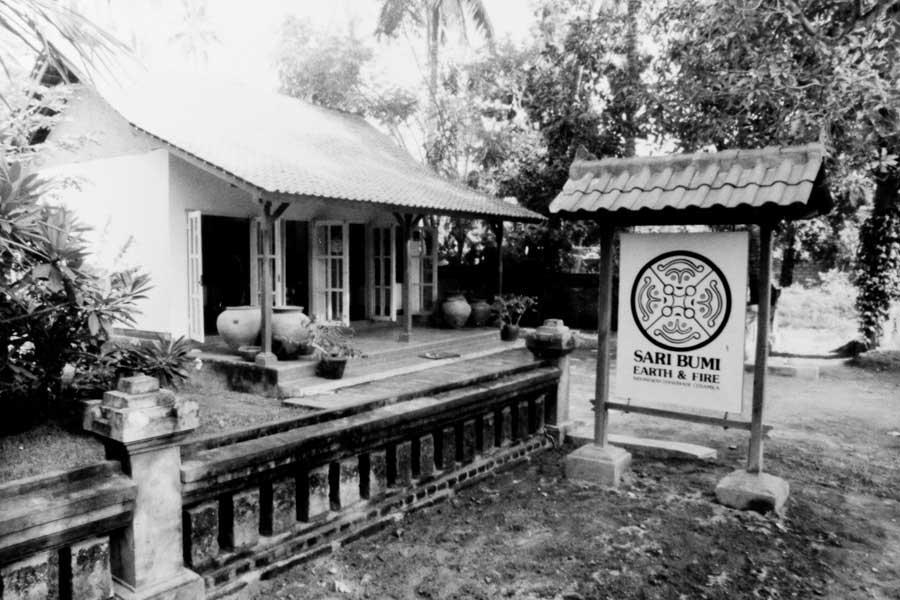
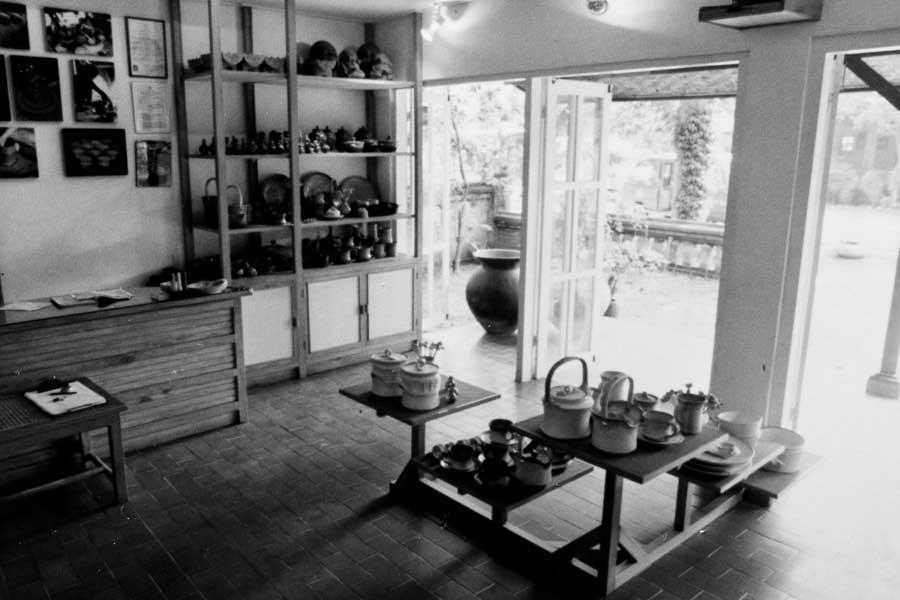
While the company was named Jenggala right from its inception in 1976, its first public face was a modest retail shop named Sari Bumi, which translates to the essence of the earth. Siting this storefront in Sanur allowed the founders to share their early pieces directly with residents and global travellers.
The choice of the company name, Jenggala, carried a deliberate, grounded historical weight. It references the eleventh-century Hindu-Buddhist kingdom of Janggala in East Java, a name derived from a Sanskrit term for wilderness or forest. The historical kingdom was established when King Airlangga famously divided his realm to ensure a peaceful succession for his sons.
Airlangga himself embodies the ultimate historical bridge between Java and Bali, mirroring the geographical spirit of the new studio. He was born from a dynastic marriage between Queen Mahendradatta, a princess of the East Javanese Ishana dynasty and sister of King Dharmawangsa of Mataram, and King Udayana Warmadewa of the Balinese Warmadewa dynasty. By anchoring their identity in the name Jenggala, the founders quietly linked their contemporary creative studio to centuries of shared regional history and cross-island cultural alignment.
The physical location of the Sari Bumi storefront sat just behind the landmark Batujimbar Estate, a residential project initially led by the Sri Lankan architect Geoffrey Bawa alongside Australian artist Donald Friend and Wija Waworuntu himself. This creative lineage heavily influenced the neighbourhood pocket in Sanur, which evolved significantly over the subsequent decades, tracing a clear path of intentional, slow growth.
This dynamic landscape expanded when Iskandar Waworuntu, the son of Wija and brother of Ade, established the Temuku Pupuan farm in 1988 in the hills of Pupuan. Operating as one of the very first farm-to-consumer farmlands in Bali, the project bridged rural agriculture directly with local tables. In the early 1990s, Iskandar opened the original Cafe Batujimbar in Sanur, adjacent to the Sari Bumi shop and the estate grounds, creating a natural storefront for the harvest.
Aviadi explained that this development followed the exact same purposeful pattern as the pottery studio. “Like Tandjung Sari and Jenggala, Cafe Batujimbar was created to fulfil a specific need, too,” he shared with Paras. Iskandar and his wife, Darmilla, utilised the fresh produce to shape a new neighbourhood gathering point. “The café accommodates their combined desire to showcase fresh ingredients from the farm and Darmilla’s skilful cooking,” Aviadi noted, while also giving travellers staying at the hotel an inviting new option for their daily meals.
While Iskandar later moved permanently to the hills of Imogiri in southern Yogyakarta to establish the Bumi Langit institute, he continues to fiercely champion conscious living with a strong emphasis on mindful farming and ecological alignment. This neighbourhood pocket in Sanur became a home for long conversations, creative connection, and good food presented on honest tableware.
The Jimbaran Transition
By the mid-1990s, the original workshop and office space in Sanur had outgrown their physical limits due to increasing demand. To accommodate the studio’s steady growth and prepare for the future, construction began on a new, expansive facility in Jimbaran in 1995. This major project aimed to bring the entire production workshop, corporate office, and main warehouse together under a single, unified roof.
The construction phase concluded in 1997, a year that coincided directly with the onset of the severe Asian Financial Crisis. Completing a large-scale physical expansion during a period of intense regional economic instability presented an immense test of resilience for the team. However, this timely consolidation ultimately secured the future of the enterprise, allowing the workshop to expand its technical capacity and build larger, more efficient kilns.
While the physical footprint grew, the human element remained entirely uncompromised. Ade Waworuntu clarifies that physical space does not mean a shift towards automation. “Some large companies operate on a full factory scale, producing ceramics with automated machinery 24/7,” Ade noted in a reflection shared with Channel News Asia. “Jenggala is not like that, and will never be.”
She emphasises that despite the grand scale of the building, the heart of the operation remains intimate. “Our production site looks big, indeed, but it’s small compared to other major ceramic makers. That’s why we prefer to call it a workshop rather than a factory. All of the details are made by hand. Even the mug holders are still being attached by hand.”
Crucially, this facility was envisioned as more than just a place of manufacturing. To share the tactile joy of pottery, the space introduced dedicated ceramic making and ceramic painting workshops. This allowed enthusiasts, visitors, and travellers to step behind the scenes, touch the clay, apply glazes, and experience the rewarding process of creation firsthand, transforming the facility into an interactive space.
Ade Waworuntu: Leadership as a Quiet Anchor
Following the loss of her father, Wija, in 2001, and Brent Hesselyn the following year, the responsibility of guiding Jenggala through its next chapters fell squarely to Ade Waworuntu. Having been part of the workshop since its first days in 1976, Ade stepped into the principal leadership seat not just as an administrator, but as the guardian of the brand’s foundational spirit.
Ade’s leadership style has always been defined by a deep commitment to the people behind the pottery wheels. Rather than adopting a rigid corporate hierarchy, she is known warmly as the mother figure of the workshop. Her approach emphasises stability, safety, and mutual respect, which became incredibly vital as she steered the company through regional travel downturns in the early 2000s. Under her direction, Jenggala balanced the preservation of classic design principles with the logistical realities of a modern international brand, proving that a company can expand its global footprint without losing its core identity.
From Simple Plates to Global Landmarks
The restraint in Jenggala’s design language eventually caught the attention of architects and interior planners worldwide. The clean, organic lines developed by the team avoided ornate patterns, opting instead for forms inspired by the immediate environment, such as the curve of a banana leaf, the symmetry of a lotus flower, and the smooth surface of river stones.
Among these early design explorations, the stylised form of the Cili motif emerged as a defining breakthrough. Representing Dewi Sri, the goddess of rice and fertility, the Cili profile references traditional palm-leaf offerings through a clean, geometric silhouette. This elegant distillation of the island’s culture eventually became Jenggala’s official logo and its most celebrated signature collection, capturing the studio’s ability to balance ancient symbolism with functional utility.
The studio’s first major step into large-scale hospitality design began closer to home, testing their ability to scale this organic aesthetic. “Grand Hyatt Nusa Dua was our first big client,” Ade recalled of that pivotal era. “And we were not only supplying tableware. The hotel ordered many things, including lamps, wooden decorations and woven baskets.” This massive commission proved that the workshop could adapt to a wide range of interior pieces while keeping its tactile identity intact.
This versatility allowed Jenggala to build enduring global partnerships far beyond Tandjung Sari. Many of these relationships span decades; Aman, for example, has collaborated with the studio for over twenty years to create site-specific collections, with properties as far-reaching as the palatial Amanzoe in Greece utilising Jenggala tableware.
Jenggala’s design language shifts naturally to suit the character of each environment. For Aman, this means matte, earth-toned glazes that blend with the landscape, while Bulgari requires sharp, meticulous precision. The studio shapes clean, geometric profiles for Alila’s minimalism and fluid contours for Banyan Tree’s quiet spaces. For W Hotels, the forms become bold and deeply saturated, while Desa Potato Head relies on durable, functional pieces with contemporary, innovative lines.
This adaptive capability translates equally well to the global speciality food and beverage sector. Jenggala designs custom vessels for contemporary coffee roasters like Tanamera Coffee, speciality spaces like Starbucks Reserve, and a wide variety of independent restaurants around the world that value the tactile honesty of handmade ceramics.
Fifty Years on the Table
Looking back from the vantage point of 2026, Jenggala’s fifty-year journey illustrates the enduring value of steady, grounded progress. What began as a practical solution to a hotel’s broken plates has spent half a century quietly defining the material culture of Indonesian hospitality.
The partnership initiated by the Waworuntu family and Brent Hesselyn demonstrated that good design does not need to be loud or overly complicated to endure. It requires an understanding of raw materials, a willingness to survive infrastructure challenges, and a steady hand at the helm.
“Until today, our family continues to run Tandjung Sari, Jenggala, and Cafe Batujimbar,” Aviadi says. This continuous, generational care ensures that the original spirit of Sanur remains entirely intact. Today, under Ade’s quiet guidance, the Jimbaran workshop continues to produce pieces that feel contemporary yet familiar, reminding us that the objects we gather around our tables anchor our meals, our conversations, and our daily rituals in something solid, real, and beautifully made.