
Balibo Declaration
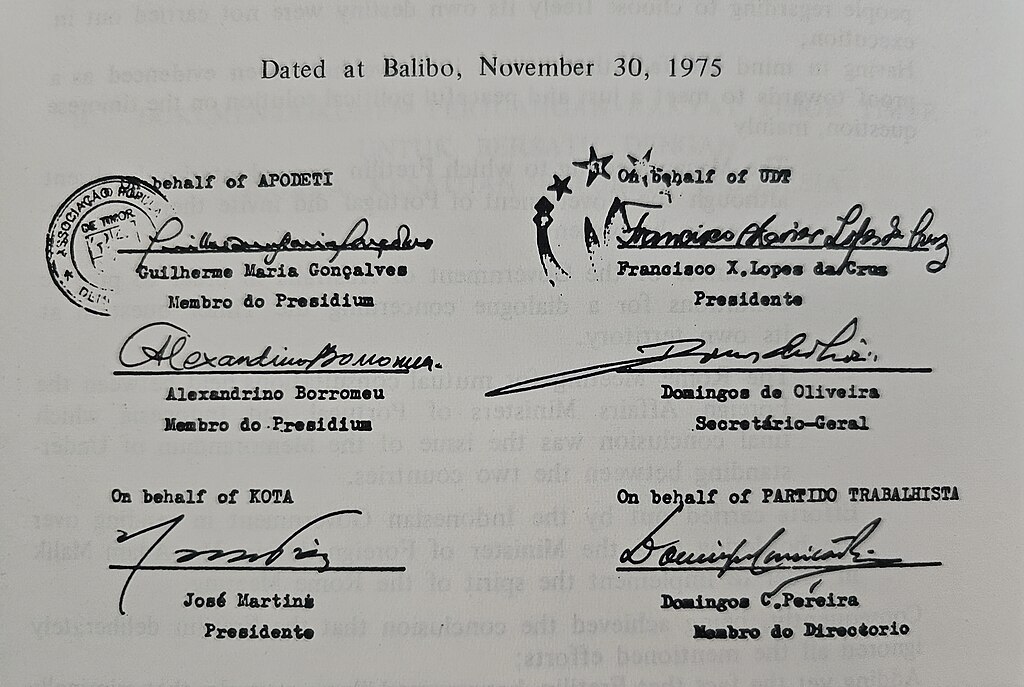
The Balibo Declaration, dated November 30, 1975, was recognised by some as a document drafted to serve as the legal basis for the military invasion, Operasi Seroja (Operation Lotus), which commenced on 7 December 1975, and subsequent annexation of East Timor, which extended from 1975 to 1999. The document’s status is defined by its signing location and a resulting nickname.
The declaration claimed to represent the expressed wishes of East Timorese leaders (UDT, APODETI, KOTA, and Trabalhista) for integration with Indonesia. It was not signed in East Timor. The signing occurred at a hotel in Denpasar, Bali, Indonesia. The name of the hotel is not consistently recorded in all historical accounts. The text of the declaration was drafted by Indonesian intelligence officials (BAKIN) and signed on Indonesian territory. The naming of the document led to the nickname: ‘Balibohong.’ This name combines the town of Balibo with the Indonesian word Bohong, meaning ‘lie’ or ‘falsehood.’ ‘Balibohong’ was used by opponents of the integration.
Decolonisation of East Timor and the Call for Independence
The context for the event was the 1974 ‘Carnation Revolution’ in Portugal, which initiated the decolonisation of its overseas territories. In Portuguese Timor, three main political factions rapidly emerged; FRETILIN (Revolutionary Front for an Independent East Timor), which advocated for immediate and full independence, UDT (Timorese Democratic Union), APODETI (Timorese Popular Democratic Association).
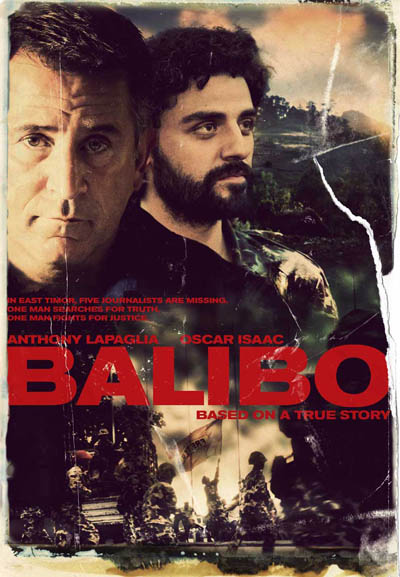
Internal conflict escalated into a civil war in August 1975, with FRETILIN forces gaining control of the capital, Dili, and most of the territory. On 28 November 1975, FRETILIN unilaterally declared the independence of the Democratic Republic of East Timor. Indonesian covert operations began seizing border towns, including Balibo, where five foreign journalists (known as the Balibo Five) were killed by Indonesian forces on 16 October 1975, shortly before the full-scale invasion.
The 25-Year Occupation and Its Human Toll
The conflict resulted in a high number of deaths relative to the population. The final report by the Commission for Reception, Truth and Reconciliation in East Timor (CAVR) estimated the number of conflict-related deaths from violence and starvation / disease between 1975 and 1999 to be between 90,800 and 202,600. This figure represents approximately one-third of the 1975 population.
Resistance continued, comprising armed fighters and clandestine networks. This resistance, along with political changes including the resignation of Indonesian President Suharto in 1998, led to a UN-sponsored Popular Consultation in August 1999.
Conclusion of the Occupation
In the 1999 referendum, 78.5% of East Timorese voters rejected the offer of special autonomy within Indonesia, opting for independence. After the vote, subsequent systematic actions by pro-integration militias and the Indonesian military occurred, after which Indonesia withdrew. East Timor was placed under United Nations administration (UNTAET) and achieved independence in 2002.